 Written by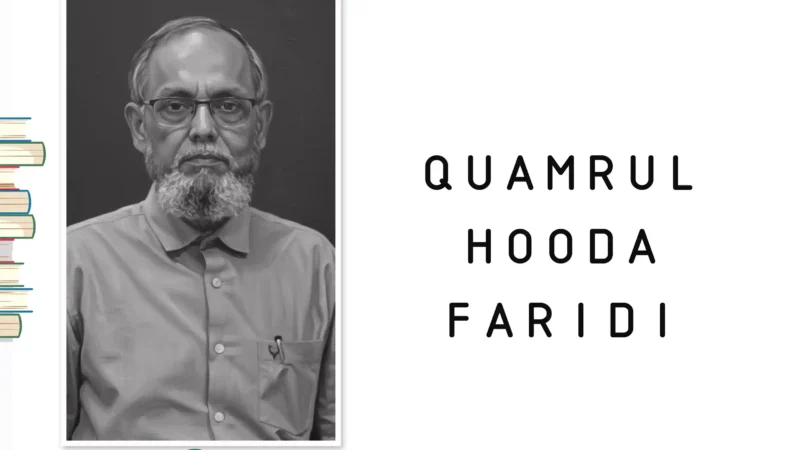
Prof. Mohamed Quamrul Hooda Faridi stands as a distinguished scholar and academic in the field of Urdu literature, currently serving as a professor in the Department of Urdu at Aligarh Muslim University (AMU), India. Born on December 11, 1962, into a family rooted in strong scholarly tradition—his father being Maulana Abdus Salam Faridi—he has carved a niche for himself through rigorous research, prolific writing, and dedicated teaching. His academic journey is marked by a Ph.D., M.Phil., M.A. in Urdu, along with a Diploma in Linguistics, showcasing a broad and deep engagement with linguistic studies.
Beginning his professional career at AMU in 1993 as a lecturer, he progressed to become a reader in 2002 and a full professor by 2010. His academic excellence was recognized early on with awards such as the P.G. Merit Scholarship in consecutive sessions (1981-82 and 1982-83) and a scholarship from the U.P. Urdu Academy in 1984. Moreover, he qualified the National Educational Test (NET-JRF) in 1985 and held Junior and Senior Research Fellowships during his postgraduate research tenure. His scholarly work has earned prestigious awards from institutions including the U.P. Urdu Academy and the Bihar Urdu Academy, notably for important books such as “Urdu Dastan: Tahqeeq-o-Tanqeed,” “Tilism-e-Hoshruba Tanqeed-o-Talkhees,” and “Urdu Nasr: Asnaf-o-Asaleeb,” the latter earning the Kalimuddin Ahmad Award.
Professor Faridi has demonstrated strong leadership in academic coordination, overseeing multiple refresher courses in Urdu at AMU and Urdu Academy, including specialized programs for school teachers. He has also been the convener of significant national seminars hosted by AMU, focusing on themes such as “Arabi-o-Farsi Qasida Nigari,” “Majaz Aur Unka Ahd,” and “Hali aur Amali Tanqeed,” which reflect his expertise in both classical and contemporary Urdu literary criticism.
In editorial roles, he has significantly contributed to the scholarly discourse as joint editor, editor, and co-editor of key Urdu literary journals like “Tahzibul Akhlaq,” “Alfaz,” “Tanqeed,” and “Danish,” the latter linked to AMU’s Faculty of Arts. His mentorship is highlighted by guiding twelve Ph.D. scholars and one M.Phil candidate to successful degrees, with current supervision of six ongoing research projects in Urdu literature.
His extensive publication record spans seventeen books that include original studies, critical editions, and compilations, such as “Ek Marka Lahu Ka” (1984), “Sir Syed Aur Urdu Zaban-o-Adab” (1989), and a monograph on “Hasrat Mohani” (2017). He has also authored 69 research papers across reputed journals and contributed numerous articles, demonstrating a sustained engagement with Urdu literary scholarship over decades.
Beyond research and publication, Prof. Faridi has played vital academic and administrative roles, including secretaryship positions in Urdu societies, membership in the AMU court, wardenship, and overseeing literary and cultural activities at AMU halls. His commitment extends to active participation and leadership in workshops, seminars, and conferences nationally and internationally, addressing various facets of Urdu language, literature, culture, criticism, and linguistics.
His contributions have been widely appreciated by prominent scholars and documented in various academic reviews and books, establishing him as a leading figure in contemporary Urdu studies at Aligarh Muslim University and beyond.
This detailed biography underscores Professor Faridi’s multifaceted achievements as a scholar, educator, editor, mentor, and academic leader in the field of Urdu literature and linguistics. His enduring legacy is reflected in his scholarly works, academic programs, and the profound influence he has had on students and peers alike, advancing the understanding and appreciation of Urdu language and literature.
This account is strictly based on the comprehensive curriculum vitae document provided by Prof. Mohamed Quamrul Hooda Faridi.
Publications
Books Authored/Edited (17 Books)
- Ek Marka Lahu Ka (1984; Revised 2017)
- Sir Syed Aur Urdu Zaban-o-Adab (1989; Revised 2017)
- Urdu Dastan: Tahqeeq-o-Tanqeed (1991; 2nd Ed. 2002)
- Tilism-e-Hosh Ruba: Tanqeed-o-Talkhhees (1999)
- Masnavi Gulzar-e-Naseem (Edited, 2000; New edition 2017)
- Masanvi Sehrul Bayan (Edited, 2001)
- Bagh-o-Bahar (Edited, 2002; New edition 2021)
- Sabras (Edited, 2007; New edition 2020)
- Urdu Nasr: Asnaf-o-Asaleeb (2007; New edition 2013)
- Intikhab-e-Nasr-o-Nazm (Edited, 2007)
- Muasir Urdu Adab (Compiled, 2007)
- Ghair Afsanavi Adab: Ek Intikhab (Edited, 2008)
- Iktisab-o-Ehtisab, Aligarh (2010)
- Izhar-o-Iblaqh (2010)
- Majaz Aur Unka Ahd (Compiled, 2013)
- Hali aur Amali Tanqeed (Compiled, 2015)
- Hasrat Mohani (Monograph, 2017)
Research Papers Published (69 Papers)
Notable recent papers include:
- “Dastan : Mutakhalif Quwwaton Ke Tasadum Ki Ek Jihat” (2020)
- “Yusufi ka Nishan-e-Imtiyaz” (2019)
- “Shaikh Abdul Haq Muhaddis Dehlavi : Ahwal-o-Asar” (2019)
- “Hasrat Mohani: Siyasi Aur Samaji Kirdar” (2018)
- Various papers in reputed journals like Tahzibul Akhlaq, Fikr-o-Nazar, Danish, etc., on topics ranging from Urdu literary criticism, history, linguistics, and specific literary figures.
Articles Published (20 Articles)
Examples:
- “Nashat-e-Jaan Se Karb-e-Wojud Tak” (2017)
- “Syed Hamid: Shakhsi Aur Adabi Hawale” (2015)
- “Baba Fareed: Silsila-e-Chishtiya Ke Jalilul Qadr Buzurg” (2009)
- Various articles in journals and compiled books addressing thematic, critical, and historical subjects related to Urdu literature.
Awards and Scholarships
Scholarships
- P.G. Merit Scholarship (1981-82 & 1982-83)
- U.P. Urdu Academy Scholarship (1984)
- National Educational Test (NET-JRF) qualification (1985)
- Junior Research Fellowship (JRF) during M.Phil
- Senior Research Fellowship (SRF) during Ph.D
Academic Awards on Books
- U.P. Urdu Academy Awards:
- Urdu Dastan: Tahqeeq-o-Tanqeed
- Tilism-e-Hoshruba Tanqeed-o-Talkhees
- Izhar-o-Iblagh
- Bihar Urdu Academy Award:
- Sir Syed Aur Urdu Zaban-o-Adab
- Kalimuddin Ahmad Award for the book “Urdu Nasr: Asnaf-o-Asaleeb”
Last modified: November 24, 2025
