 Written by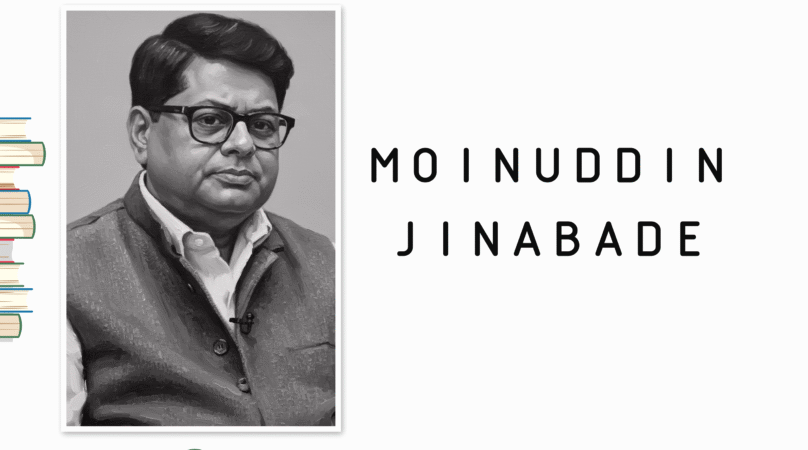
Moinuddin A. Jinabade stands at the confluence of scholarship and imagination, a rare presence whose work unfurls across the vast terrains of Urdu literature, criticism, and the lived ethics of language. A scholar of textual precision and a creator of luminous prose, he has, over decades, given Urdu a meticulous reader, an exacting editor, and an artist of quiet intensity. As professor at the Centre of Indian Languages in Jawaharlal Nehru University, New Delhi, he cultivated an intellectual climate where literature was not merely taught but patiently interrogated and lovingly restored to its historical breath. His life’s arc—beginning in the classrooms of Mumbai University and rising through roles of responsibility and stewardship—has been animated by an unbroken fidelity to language: its textures, its theories, its inheritance, and its future.
Origins of a literary temperament
Some scholars rise through the edifice of ideas; others grow out of the soil of literature. Dr. Jinabade belongs to both genealogies. His early sensibilities were shaped by the plural idioms of Mumbai, where language is not an instrument but a habitat. In this milieu, Urdu was not a discipline alone; it was a space of memory, of argument, of detail. From the outset, he read with a craftsman’s patience: words as materials, texts as living objects—altered by time, copied by hands, burdened by histories, and in need of attentive renewal. The critic’s acuity and the storyteller’s intuition thus matured together, each checking the other, each deepening the other’s reach.
A scholar forms his method
The doctoral work that crowned the first phase of his career—his critical edition and analytical study of Diwan-e-A‘jiz Aurangabadi—was not merely an academic credential; it was a declaration of method. To edit is to listen for fidelity: to trace variants, weigh witnesses, restore lineages, and return a work to its intelligible form without erasing the marks of its journey. In this edition, rigor became a form of reverence. The poet A‘jiz, rescued from the haze of secondary mention, was restored to a dialogic relation with the present. The study joined philology with criticism, aligning poetics and history, reconstructing context while protecting the grain of the poem. This project would foreshadow a career-long devotion to Urdu’s archival intricacies and interpretive demands.
Mumbai to Delhi: a widening circle
At Mumbai University, where he began as a lecturer and rose to Reader and Head of the Department of Urdu, he learned to balance literature’s inner life with the responsibilities of institution-building. Curricula were tuned to the pulse of criticism and textual practice; mentorship became a form of scholarship; departmental culture evolved in concert with the needs of students, critics, and the city’s literary public. When he moved to Jawaharlal Nehru University in 2007, he entered a wider arena—one that demanded not only teaching and research but also stewardship of language as a public good. At JNU, his tenure as Professor created corridors of dialogue between classical poetics and modern theory, between Deccani inheritances and contemporary interpretive frames, between literary history and the living urgencies of translation, rights, and representation.
The compass of inquiry
His fields of specialization form an arc as broad as they are coherent. In criticism and critical theory, his work takes literature seriously as thought: an archive of arguments about form, ethics, power, and memory. In textual analysis, he treats the page as a palimpsest, attentive to the movement of words across manuscripts, editions, and pedagogical lives. In translation studies, he watches how meanings travel—what they lose, what they recover, what new tones they discover in transit. Deccani Urdu literature, with its layered registers and regional vitality, gives him a laboratory of forms through which to think about language as culture. Alongside these, his engagement with political philosophy, human rights, and minority languages frames literature not only as aesthetic event but as social act—where voice, access, and survival enter the critic’s responsibility.
The making of books
The corpus of his authored works—spanning inquiries into interpretation, pedagogy, narrative tradition, textual editing, and literary history—reads like a map of Urdu’s inner workings. Books on critical comprehension and the teaching of Urdu language and literature reveal a pedagogue who respects difficulty and welcomes readers into it without condescension. Studies of narrative practice in Urdu trace a tradition that is at once classical and modern, inward-looking and porous to world literatures. Works on Dabistans and Deccani legacies stitch together regions, centuries, and rhetorical worlds. Editorial projects exhibit fidelity to textual life: an ethics of caretaking married to the intellectual demands of establishing, annotating, and interpreting a work so that it may endure beyond mere citation.
The storyteller at his desk
Parallel to the critic is the short-story writer who moves in the twilight between idea and experience. His fiction is shaped by the same habits that govern his scholarship: a love of nuance, a suspicion of the too-tidy conclusion, a patience with ambiguity. Here, imagination is not decoration; it is inquiry by other means. The stories look outward to the world’s roughness and inward to the tremors of conscience, attentive to social texture, emotional weather, and the fragile architectures of language through which people name their lives. That his stories travel across journals and geographies is not incidental—his prose knows how to belong in multiple rooms at once.
The bridge of translation
His translations of Marathi short stories into Urdu belong to a lineage of writers who treat translation as kinship. Translation, in his hands, is neither servile nor imperial; it is a negotiation of temperature and tempo. He listens for cadence, not just meaning; for idiom, not just equivalence. By bringing Marathi narratives into Urdu, he opens doors across the house of Indian languages, letting one room illuminate another. The exercise also sharpens his critical practice, making him alert to what languages owe each other, and to what they must not take by force.
Teaching as vocation
To teach is to model how to read. In his classrooms, texts were not exhausted by explanation; they were enlarged by it. He asked of students what his own work asks of readers: dwell in the sentence, follow the argument to its quiet endpoints, keep company with a poem until it starts to speak in its own timbre. Mentorship, for him, meant giving young scholars both tools and trust—tools to edit, translate, historicize, theorize; trust to test those tools against recalcitrant material without fear of error. Many who passed through his care found themselves apprenticed not to a doctrine but to a discipline: the discipline of responsible reading.
Public humanities and the life of letters
Beyond the seminar room, he has served as a public interlocutor for Urdu—on stages, in festivals, and within literary circles where criticism meets community. Here, he argues for a literary culture that is porous, dialogic, and generous: where canon and experiment meet without suspicion; where the Deccani inheritance is not a curiosity but a living fountain; where Urdu’s urban modernities can converse with its classical reservoirs without anxiety. His presence in such forums testifies to a conviction that literature survives not by isolation but by circulation—through classrooms, libraries, translations, conversations, and the long patience of readers.
Honors and the quiet of work
Recognition has followed the work, but the work has never chased recognition. The esteem he commands rests on the sturdiness of his scholarship, the clarity of his prose, and the reliability of his editorial hand. Colleagues have trusted his judgment; students, his attention; readers, his voice. If distinctions have adorned his career, they do so as garlands after the labor, not as the point of it. What lasts is the page he makes more legible, the poem he makes more audible, the field he makes more habitable.
A legacy in motion
To read the arc of Dr. Moinuddin A. Jinabade’s life is to witness an ethics of care: for text, for reader, for language, for the communities that languages sustain. The editor preserves a lineage, the critic clarifies a horizon, the storyteller enlarges the realm of feeling, and the translator builds a bridge—together composing a single vocation. If literature is, as often said, a house with many doors, his contribution has been to keep those doors open, to oil their hinges, to label their rooms without limiting their uses. He has shown how Urdu can be taught without being tamed; how its history can be recovered without being embalmed; how its stories can cross borders without losing their breath.
And so his influence persists—in syllabi and shelves, in citations and sentences, in the sensibilities of younger scholars who learned from his patience, and in the readers who found, in his pages, the clarities they needed and the mysteries they wished to keep. In an age of haste, he has practiced attention; in a time of noise, he has practiced listening. The result is a body of work that does not shout its importance but proves it—line by line, edition by edition, story by story—leaving Urdu studies, and the wider republic of Indian languages, quietly and indelibly changed.
⁂
Last modified: October 13, 2025
