 Written by
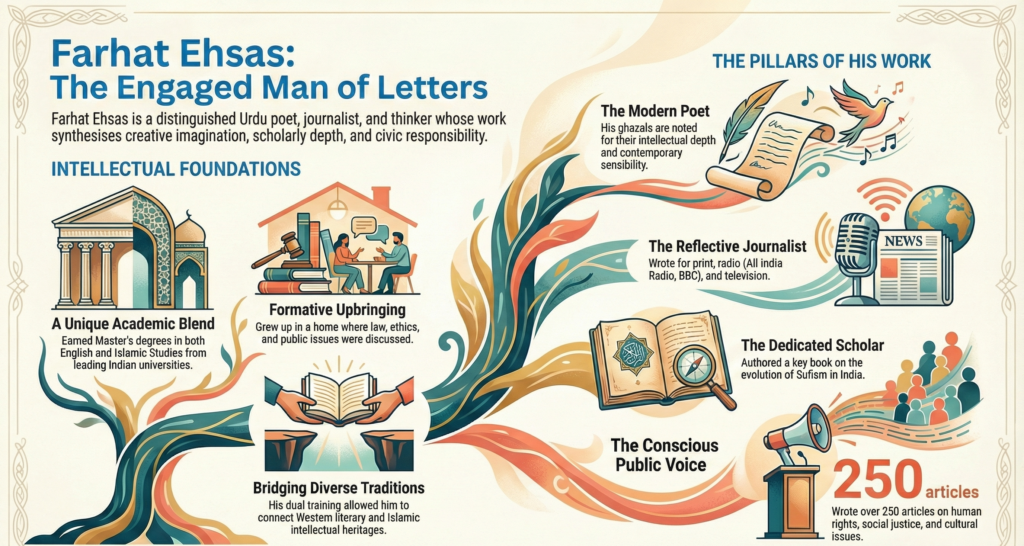
Farhat Ehsas is a distinguished Urdu poet, journalist, translator and thinker whose writings remain in close and living contact with the social, cultural and political realities of his age. His personality brings together, in a rare balance, the sensibility of a poet, the discipline of a scholar, the vigilance of a reflective journalist and the responsibility of a public intellectual.
His real name is Farhatullah Khan, and he was born in 1952 in Bahraich, Uttar Pradesh, in a well‑known and respected family that enjoyed social prestige as well as an educated atmosphere. His father, Basharatullah Khan, was a prominent lawyer and honorary judge in Bahraich, which meant that discussions of law, ethics and public issues formed part of the natural climate of the home and helped shape a serious intellectual environment around him from childhood. He received his early education in his hometown, where the first foundations of his literary taste and curiosity about the world were quietly laid.
For higher studies, Farhat Ehsas moved to two of India’s most important centres of learning, Jamia Millia Islamia and Aligarh Muslim University, and completed an M.A. in English as well as an M.A. in Islamic Studies. This uncommon combination of classical and modern disciplines, of Western literary tradition and Islamic intellectual heritage, gave his mind a wide horizon and a firm conceptual grounding, enabling him to read texts from multiple angles and to relate diverse traditions of thought to one another. In his later writings, this dual training emerges as a steady undercurrent, lending both breadth and depth to his reflections on literature, religion, culture and contemporary life.
In the field of research and academic writing, Farhat Ehsas has been closely associated with the Zakir Husain Institute of Islamic Studies at Jamia Millia Islamia, New Delhi, where he worked as Assistant Editor of a research journal. In this capacity, he engaged with articles dealing with Islamic thought, history and culture, and contributed to maintaining rigorous scholarly standards in the journal’s editorial processes. In 1998 he was further associated with the editorial work of the English quarterly Islam and the Modern Age and the Urdu journal Islam aur Asr‑e‑Jadeed, both brought out by the same institute, which placed him at a crucial intersection of tradition and modernity in intellectual discourse.
On Sufism he authored an important book titled Tasawwuf aur Hindustani Tasawwuf, a work that reflects his deep engagement with the spiritual and intellectual legacy of the Indian subcontinent. In this book he examines the roots and evolution of Sufi thought in the Indian context, showing how mystical ideas interacted with local cultures and languages and how a distinct Indo‑Islamic spiritual sensibility emerged over time. The book, as indicated in the available information, stands as a representative example of his inclination towards reflective, research‑based writing, even though it is the only one of his scholarly works explicitly mentioned in the given source.
Farhat Ehsas began his professional life as a freelance journalist, entering a field where responsiveness to current events and clarity of expression are constantly tested. This initial phase allowed him to sharpen his analytical skills and to develop a personal voice capable of linking daily happenings with larger social and moral questions. Later he joined the well‑known Urdu daily Qaumi Awaz in New Delhi, where he supervised the literary supplement and promoted a form of creative journalism. In that space, he brought literature, society and politics into sustained dialogue, inviting readers to see literary texts not as isolated aesthetic objects but as participants in public life and ethical debate.
His association with electronic media extended his reach beyond the printed page. For a long period he wrote commentaries, analyses and features on current affairs for All India Radio, addressing a diverse and often multilingual audience. His commentaries were also broadcast by BBC Radio, which shows the recognition of his interpretive insight at an international platform, and he appeared on television programs devoted to literary discussion and critical conversation. Through these engagements, he contributed to shaping a thoughtful public sphere in Urdu, where literature and criticism converse with news, power and everyday experience.
Alongside his poetic work, Farhat Ehsas has been an active essayist and columnist, regularly contributing to newspapers and literary journals. He has written more than 250 articles on social, cultural, political and civilizational issues, as well as on national and international human situations, indicating not only prolific output but a sustained, observant engagement with the changing conditions of contemporary life. His writings show a sensitivity to suffering and injustice, a concern for human dignity, and a constant effort to interpret events within broader historical and ethical frames.
Critics note that his prose displays intellectual seriousness, evidence of wide reading and a strong, often graceful control over language. His essays published in various literary journals and newspapers are held in high regard in academic as well as literary circles, where they are valued for their combination of clarity, subtlety and principled argument. Through this body of prose he has emerged as a significant voice in modern Urdu non‑fiction, someone who does not merely comment on events but seeks to understand their deeper implications for society and culture.
The poetic dimension of Farhat Ehsas has received appreciative attention from critics and compilers of modern Urdu literary history. In the book Tazkira‑e‑Shora‑e‑Bahraich, Nemat Bahraichi portrays him as an eloquent and gifted poet with a distinctly modern tone and style, whose poetry is marked by seriousness, dignity and a refined, controlled language. In this view, his verse unites intellectual depth with contemporary sensibility, and his ghazals, in particular, are seen as linked with the major trends of the modern Urdu ghazal while retaining an individual voice.
Professor Wahab Ashrafi, in the third volume of his Tareekh‑e‑Adab‑e‑Urdu, counts Farhat Ehsas among the notable poets of the new generation and draws attention to the reflection of his wide reading and scholarly capacity in both his prose and his poetry. He observes that the ghazals of Farhat Ehsas possess a distinctive “temper” and a dialectical use of words; familiar ideas and classical images appear in new moulds, and old metaphors are recast in fresh contexts. This subtle renewal lends his poetry a sense of originality and freshness, allowing it to converse with tradition without being confined by it.
Farhat Ehsas is not only a creative writer working within the boundaries of literature; he is also a socially conscious observer of his time. He has consistently written about human rights, social justice and cultural identity, and has engaged with the shifting patterns of global politics with a voice that is both morally alert and intellectually careful. In doing so, he brings to Urdu public discourse a tone of principled concern, resisting simplification and easy slogans while remaining responsive to the pain and anxieties of ordinary people.
He is a representative figure of a modern Urdu literary temperament in which poetry, research, journalism and critical reflection move forward together rather than in isolation. In his person, these different modes of writing and thinking form a coherent whole and reinforce one another, creating an example of the engaged man of letters. This rare combination of creative imagination, scholarly depth and civic responsibility has earned Farhat Ehsas a distinct and dignified place in the contemporary Urdu literary landscape.
Farhat Ehsas Rekhta urdu poetry Urdu Shahiry
Last modified: December 7, 2025